 Business License

Blog Post: Navigating Commercial Kitchen Ventilation Compliance: How to Meet NFPA 96 and Local Code
Why Compliance Matters (Beyond Avoiding Fines)
Key Standards to Master: NFPA 96 and Local Variations
Hood Sizing & Placement: Hoods must cover all cooking equipment (grills, fryers, ovens) with a minimum 6-inch overhang on all sides. For high-heat equipment (e.g., charbroilers), hoods must extend 12 inches beyond the equipment to capture excess smoke.
Exhaust Airflow Rates: The system must move enough air to remove grease and fumes—measured in cubic feet per minute (CFM). For example:
Fryers: 300–400 CFM per linear foot of equipment
Charbroilers: 500–600 CFM per linear foot
Combination equipment (e.g., grill + oven): 450–550 CFM per linear foot
Grease Filtration: All systems must use UL-listed grease filters (either baffle, mesh, or electrostatic) that capture at least 85% of grease particles. Filters must be accessible for daily cleaning.
Duct Design: Ducts must be made of 16-gauge stainless steel (to resist corrosion and fire) and have smooth interiors (no ridges where grease can accumulate). Ducts cannot pass through living spaces or storage areas.
Cleaning Schedules: Ducts and hoods must be professionally cleaned:
Monthly for high-volume kitchens (e.g., 24/7 diners, fast-food chains)
Quarterly for medium-volume kitchens (e.g., hotels, casual restaurants)
Semi-annually for low-volume kitchens (e.g., school cafeterias with limited service hours)
How to Choose a Compliant Ventilation System
Passing Inspections: A Step-by-Step Prep Guide
Gather Documentation: Have records of:
Pre-Inspection Walkthrough:
Address Issues Proactively: If you find a problem (e.g., low airflow, dirty ducts), fix it before the inspection. Waiting can lead to fines or shutdowns.
Long-Term Compliance: Build a Routine
Recently Posted
-
AIRWORK full range hood: customized ventilation solution suitable for diverse commercial scenarios
November 27, 2025Every commercial kitchen is unique—whether it’s a five-star hotel’s open display kitchen, a hospital’s central kitchen, a restaura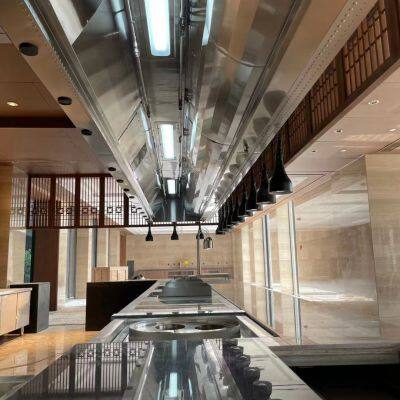 Read More
 -
AIRWORK: Global leader in comprehensive air quality solutions for commercial kitchens
November 27, 2025In the commercial kitchen sector, where air quality, safety, and efficiency are paramount, AIRWORK stands out as a trusted joint v Read More
 -
Airwork Product Series: Tailored Ventilation Solutions for Every Commercial Kitchen Scenario
November 25, 2025Every commercial kitchen is unique. A hotel’s open display kitchen demands aesthetic appeal and odor control; a central kitchen re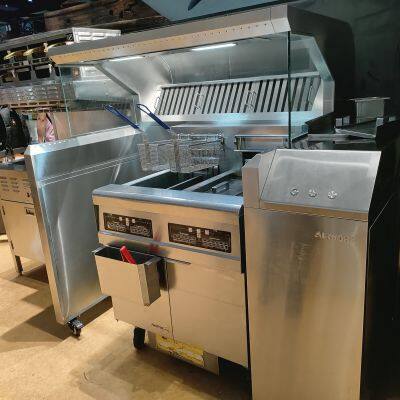 Read More
 -
Airwork: Redefining Commercial Kitchen Ventilation with Innovation, Safety, and Efficiency
November 25, 2025In the fast-paced world of commercial foodservice, a kitchen’s performance hinges on more than just culinary skill—it depends on t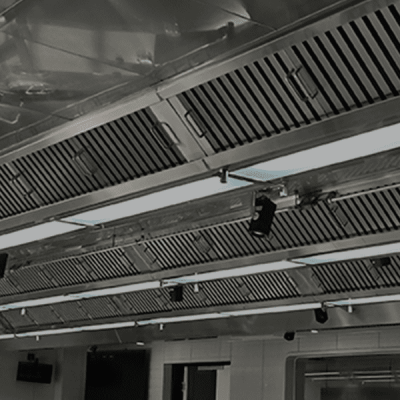 Read More

Contact Us
Recommended Products
-
 AIRWORK FWMF Heavy-Duty Commercial Kitchen Exhaust Hood With Water Mist Cooling & Automatic CleaningNegotiableMOQ: 1 Combo
 -
AIRWORK KSI Cost-Effective Single-Layer Commercial Kitchen Exhaust Hood With HG Cyclone Filter & ASL LightingNegotiableMOQ: 1 Combo
-
AIRWORK VVF Quiet & Condensation-Proof Commercial Kitchen Exhaust Hood for Dishwashing AreasNegotiableMOQ: 1 Combo
-
AIRWORK KWF Commercial Kitchen Exhaust Hood With Automatic Water Washing Tech & AIRJET Energy-Saving SystemNegotiableMOQ: 1 Combo
-
AIRWORK KVI-AIRJET High-Efficiency Commercial Kitchen Exhaust Hood With AIRJET Anti-Escape & LEED-Compliant DesignNegotiableMOQ: 1 Combo